
The Roman Bath Problem

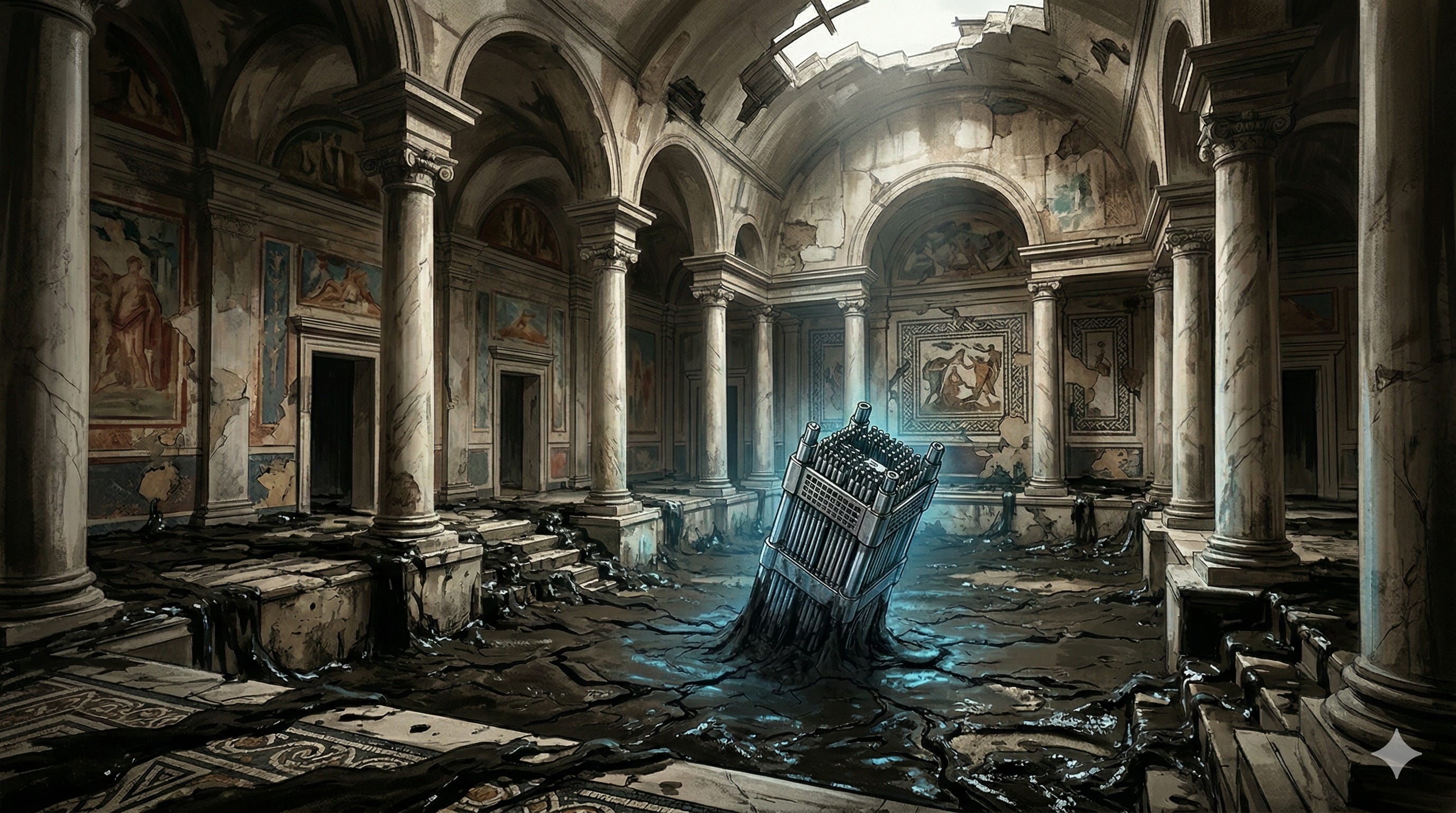
If you work in the insurance industry or grid management today, you already know the joke: ‘stationarity is dead’.1 We are currently watching 1-in-100-year weather events batter the European continent with seasonal regularity. The Jet Stream is meandering, the North Atlantic is boiling, and thanks to the ongoing closure of the Strait of Hormuz, the global flow of liquefied natural gas has been brutally bottlenecked.
As we approach this ‘resource entropy singularity’—a point of no return beyond which the forces driving resource depletion and environmental degradation become overwhelming and irreversible—the margin for civilisational error has dropped to zero. We are in a phase-space where every Joule of low-entropy energy is a matter of systemic survival.
Which is why we need to talk about what happened in Germany.
In April 2023, the German government—driven by its Green coalition partners—shut down its last three functioning nuclear power plants: Emsland, Neckarwestheim, and Isar 2. To replace that lost baseload power, they expanded the Garzweiler open-cast mine, tearing up villages and wind farms to burn lignite (brown coal).
This was not merely a political miscalculation. It was a thermodynamic crime. It stands as the ultimate case study of what happens when a civilisation’s Ideological Superstructure completely decouples from biophysical reality.
But to truly understand the depth of this error, we must look past the immediate geopolitical crisis and gaze into the far side of the singularity. We must look at the ghosts of Roman Britannia.
The Geography of Trauma
The German Green movement did not originate from a rigorous, biophysical understanding of thermodynamics or the ‘metabolic rift’. It emerged in the 1970s and 80s as a romantic, anti-industrial, and specifically anti-nuclear aesthetic.
But why was this aversion so uniquely virulent in Germany compared to its neighbours? It was a collision of geopolitics and profound historical trauma. During the Cold War, West Germany was the designated nuclear battlefield. With the stationing of Pershing II missiles and the constant threat of the Fulda Gap, ‘the atom’ did not merely represent a distant power source; it represented the literal, localised annihilation of the German nation.
When this geographical terror collided with the deep German Romantik tradition—a cultural reverence for the forest and nature—and the overwhelming psychological guilt of the Second World War, it forged a deep cultural neurosis around ‘playing God’ with Faustian technologies. The Green Party did not invent this aversion; they successfully weaponised a trauma that was already deeply embedded in the German psyche. It tapped into an emerging social consensus.
Because of this, they suffered from a profound case of ‘Exergy Blindness’. They categorised energy sources not by their thermodynamic density or their entropy gradients, but by their ideological purity. Nuclear power—despite being the most energy-dense, lowest-carbon baseload exergy source available to humanity—was deemed ideologically ‘unclean’.
The Greens prioritised a psychological preference over the mathematical reality of the baseline power balance. In doing so, they forced the system to optimise for a political aesthetic rather than thermodynamic survival.
Vaporising Embedded Exergy
The most immediate tragedy of the German phase-out lies in the concept of ‘embedded exergy’.
The capital, concrete, steel, and highly specialised labour required to build a nuclear plant represent a massive initial spike in systemic complexity and energy expenditure. But once that plant is online, that exergy is a sunk cost. The plant is now providing a steady, high-density flow of gross exergy.
To shut down fully amortised, functional nuclear reactors before their engineered lifespan is complete is to literally vaporise that embedded exergy. Because a highly complex industrial grid requires a strict, non-negotiable metabolic baseline to avoid a brittle fracture, that missing energy had to be instantly replaced. Without nuclear, the only domestic option was to tear up the landscape to burn lignite—the lowest grade of coal, with a terrible Energy Return on Energy Invested (ERoEI) and the highest carbon emissions per megawatt.
They actively flattened their own entropy gradient. They threw away a frictionless flow of power and replaced it with dirt.
The Ghost of Britannia: The Collapse of Complexity
However, the Green critique of nuclear power holds a dark, accidental truth—one revealed only when we study the historical collapse of complex societies.
When the Roman administrative and logistical subsidy withdrew from Britannia around AD 410, the province experienced a catastrophic collapse in complexity. The highly structured, low-entropy Roman nodes required a massive, continuous flow of maintenance exergy in the form of specialised labour, imported engineering knowledge, and centralised security. When that baseline power vanished, the infrastructure did not gently degrade; it shattered.
Londinium, a dense urban sink requiring a frictionless supply chain, was eventually abandoned. At Aquae Sulis (modern-day Bath), the collapse was absolute. Despite being a sacred site with a sophisticated Celtic temple long before the legions arrived, there was no gentle reversion to a lower-complexity Iron Age settlement. When the maintenance exergy of the Roman state vanished, the marvels of the hypocaust heating systems failed, the drainage collapsed, and the entire city essentially disappeared under feet of black mud and silt. It was total abandonment.
In other locations, like Viroconium (Wroxester) and the Northern Kingdoms, the populations maintained a cultural Roman identity but fell back onto pre-Roman technical skills, building great timber halls inside the decaying stone masonry of the empire. Across Britannia, the magnificent paved Roman roads were systematically stripped, their stones torn up to be used as crude building materials for local fortifications.
But here is the chilling caveat: Roman Britannia survived its transition because it possessed two vital thermodynamic advantages that we lack. First, while the Western Roman Empire had retracted, it had not yet collapsed entirely; a residual flow of maintenance exergy—trade in low-entropy goods—continued across the English Channel, providing a minor external buffer. Second, the local population still possessed pre-Roman, Iron Age agricultural technologies and skills to fall back on.
We, however, are hyper-specialised and entirely dependent on globalised supply chains. When the Resource Entropy Singularity hits, there will be no intact ‘empire’ across the water to trade with. The collapse of the global logistical subsidy will be absolute, and we will possess neither the skills nor the external buffer to soften the impact.
The Lethal Liability of the Atom
This historical reality fundamentally alters the nuclear equation.
During the ‘transition’ phase—as we attempt to downshift our political economy into sustainable, bioregional lifeboats—the embedded exergy of the nuclear fleet is an incredibly valuable bridge. We desperately need that dense power to physically construct the post-singularity infrastructure.
But afterwards, on the far side of the collapse in complexity, a nuclear plant is an apocalyptic liability.
Nuclear power is the most maintenance-heavy infrastructure ever conceived. A reactor, and critically, its spent-fuel pools, require a 10,000-year guarantee of immense civilisational complexity. They need perfectly functioning diesel generators, active water pumps, and an unbroken institutional lineage of hyper-specialised physicists just to remain safe.
If the equivalent of the ‘Roman withdrawal’ happens to the modern grid, the active cooling systems will eventually fail. When Aquae Sulis lost its maintenance, an entire city was swallowed by the earth. But if a spent-fuel pool loses its maintenance subsidy, the water boils off, the zirconium cladding catches fire, and the highly radioactive isotopes are lofted into the atmosphere. Because our hyper-financialised, short-termist markets refused to fund closed-cycle infrastructure to deal with the waste, an abandoned nuclear plant will become a thermodynamic landmine, poisoning its bioregional lifeboat for millennia.
Right for the Wrong Reasons
This is the ultimate, tragic irony of the German Greens. They may have been right about the ultimate, existential danger of nuclear power—but for entirely the wrong reasons. They opposed it based on an ideological fear, rather than a rigorous understanding of deep-time entropic risk and the inevitable collapse of complexity.
And crucially, they were too soon.
By forcing the phase-out before the singularity, while the system still desperately needed that thermodynamic surplus to transition and to safely decommission the legacy waste, they vaporised their bridge. It is a ‘Structurally Guaranteed Compromise’ disguised as environmentalism: they celebrate the installation of wind turbines, while the industrial base quietly burns millions of tonnes of lignite to keep the lights on when the wind stops.
And now, even the exorbitant LNG required to balance that fragile grid is gone. Driven by a profound, paralysing historical guilt over the Holocaust that mandates an unconditional defence of Israel—alongside a rigid Atlanticist subservience to the US—the German political establishment tethered its biophysical survival to a geopolitical powder keg. As that escalating conflict turns the Gulf region into a thermodynamic black hole, the Strait of Hormuz is choked off, detonating the very gas supply required to validate the Greens’ intermittent renewable fantasy.
We are entering an era of severe biophysical contraction. We must acknowledge the lethal, deep-time liability of the atom. But when the concrete has already been poured, turning off the reactors to dig for brown coal is not environmentalism.
It is civilisational suicide by ideology.
Milly, P. C. D., Betancourt, J., Falkenmark, M., Hirsch, R. M., Kundzewicz, Z. W., Lettenmaier, D. P., & Stouffer, R. J. (2008). ‘Stationarity Is Dead: Whither Water Management?’, Science, 319(5863), pp. 573-574.
Another great piece and very illuminating analogy with late Roman Britain but I would qualify the point about Germany's aversion to nuclear power by saying that it went significantly beyond the Green Party with a few personal experiences:
1) I was studying German at Trier University in 1987, and Trier is about as far west in Germany as you can get. Nonetheless, even though Trier is a long way from Ukraine, one year after the Chernobyl disaster the paranoia about the radiation fallout was still enormous and there were more than a few students on campus with their own Geiger counters wandering around checking safety levels.
2) Many years later, in 2007, when Germany was in the middle of a tortured debate about closing its nuclear power plants and I was a utility analyst at Deutsche Bank, I visited a fund manager in Frankfurt to discuss a report I had just published about how Germany should extend the lifetime of its nuclear power plants and put a windfall tax on the profits of doing this while hypothecating the proceeds of this tax to fund renewable investments. The fund manager -- a very conservative chap managing the largest DAX fund in Germany -- listened patiently to my arguments and then said: "I can't dispute the logic of your argument as it makes perfect sense but my heart is against it. And if you can't convince me, how are you going to convince the broader mass of the German political establishment?"
3) Four years later, in 2011, after the Fukushima accident when Angela Merkel's government set up a commission to decide on the future of Germany's nuclear plants, I made a visit to BASF to discuss energy policy with senior executives. One of them said to me over an agreeable lunch in the company canteen: "The thing is, if the ancient Egyptians had had nuclear power, the spent fuel would still be radioactive today. It is an unsafe technology."
4) The man appointed to be in charge of that commission, Klaus Töpfer, had been the German Environment Minister in the 1990s, and one of Merkel's mentors. At this time, in 2011, while leading this commission, he was also an adviser to Deutsche Bank on climate change, and as a carbon and energy analyst I would meet with him frequently. And he said to me once when I asked why the German Government was considering phasing out all of Germany's nukes: "The thing you need to understand is that in politics emotions are facts, and in Germany emotions run very high against nuclear power."
The point, I suppose, is that there was a consensus in German society that nuclear power was not safe and no longer needed, and while the epistemological basis for that view varied across different groups -- and certainly, as you say, there was a strong romantic/aesthetic aversion across a large part of society -- it nonetheless extended way beyond the Green movement.
All of that being said, I have never really understood why the aversion to nuclear power was so much stronger in Germany than in other countries closer to Chernobyl, and have never seen a good explanation of that.
Anyway, thanks for another great piece.
I understand your point about a preserving that bridge but I question whether it would have been burned anyway via waste if those nuclear plants hadnt been decommissioned. At least here in America, every advance in fuel efficiency or renewables just results in bigger, more powerful, more wasteful vehicles, homes data centersetc. Here in Portland have gas space heaters so you can sit outside a perfectly cozy bar, restaurant, or living room on a cold wet winter night chatting about IPAs or backyard chickens.
IMHO We need to solve the deathwish posing as a bipartisan crisis of stupidity before we can solve anything else.