
The Societal Blink Reflex

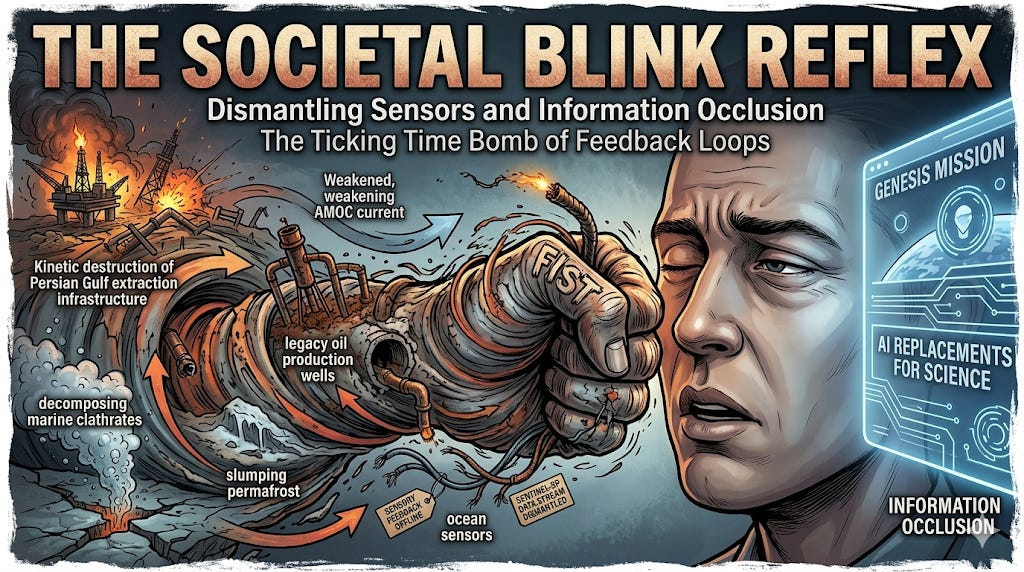
When you see a hit coming, you don’t calculate its velocity. You don’t analyse the trajectory of the fist, or assess the kinetic energy about to be transferred to your jaw. Your evolutionary programming violently seizes control of your nervous system, and you do the only thing your primate brain knows how to do in the microseconds before impact:
You close your eyes. You look away.
This is the blink reflex. It is an autonomic defence mechanism designed to protect the most vital, fragile instruments we possess. But what happens when this physiological response scales up to an entire civilisation? What happens when the fist isn’t flesh and bone, but an incoming thermodynamic phase change?
This week, we watched the global political economy flinch.
The simultaneous dismantling of the oceanic sensors1, the deliberate defunding of legacy climate monitoring networks, and the sudden, theatrical announcement of ‘The Genesis Mission2’—an initiative selling frictionless AI algorithmic simulation as a substitute for harsh physical reality—are not isolated events. The aggressive pivot towards using Artificial Intelligence as a ‘replacement’ for hard, empirical environmental science is not merely a cost-saving measure or a Silicon Valley grift.
It is an exercise in total Information Occlusion.
In my recent paper on the Socio-Economic Thermodynamic Entropy (SETE 2.0) model, I formalised this dynamic as the Information Siphon. When a complex adaptive system is algorithmically locked into a goal of endless expansion, its most existential threat isn’t just resource depletion—it is the data of that depletion. When the informational map (financialised growth) radically diverges from the biophysical territory (ecological collapse), the system must reconcile the contradiction. Because it cannot change its trajectory without risking immediate systemic collapse, it opts for the path of least computational resistance: it destroys the measurement apparatus.
We are literally masking our dashboard because the warning lights are demanding an impossible amount of exergy—usable energy—to process.
And those warning lights are blinding. If you know where to look—or rather, if you remember what was there before the sensors were unplugged—the reality of our biophysical trajectory is undeniable:
The Sentinel-5P Methane Data
Before the deliberate degradation of our observational capacities, the Sentinel-5P satellite telemetry was capturing a deeply concerning narrative. In fact, I only noticed the true scale of this departure—a terrifying step change in the methane levels compared to last year—because I was actively hunting for something else. I was looking for orbital evidence of out-gassing resulting from the kinetic disruption of operations in the Middle East.
When you look at the raw data, it becomes clear that the models, built on historical assumptions of gradual, linear emissions, are breaking down in real-time. The terrifying reality of tracking methane is that it is notoriously difficult to get an accurate read on exact emission volumes. Atmospheric concentration isn’t simply a measure of what we pump out; it is actively moderated by the availability of the hydroxyl radical sink. Crucially, hydroxyl availability is not an independent variable.
This immense, non-linear complexity creates a fog of scientific ambiguity. When the hydroxyl sink gets depleted—a dynamic now likely dominated by the rising incidence and scale of global wildfires consuming the radicals3—the methane simply lingers and accumulates. We are watching a terrifying, compounding feedback loop in real-time: the planet burns, the fires exhaust our atmospheric scrubber, and the massive out-gassing from places like the Gulf and decomposing clathrates hits the atmosphere unchecked. We are witnessing the biophysical territory radically departing from the accepted map, but because the exact mechanics are tangled in interdependent variables, it provides the perfect cognitive cover.
The Persian Gulf
This brings us to the ground truth of that kinetic destruction. The attacks on extraction infrastructure in the Persian Gulf have fundamentally fractured the spatial routing networks of global exergy, but the immediate biophysical implications extend far beyond supply-chain economics. The kinetic damage hasn’t neatly capped the wells—it has violently cracked them open.
The volatile gases previously destined for controlled combustion are now venting directly into the atmosphere. The immediate, observable effect of this uncontrolled out-gassing isn’t a uniform global rise, but massive regional increases of methane in the atmospheric air column. This invisible tide is actively mixing into the air over South Asia—a subsystem that is currently buckling under a catastrophic, 50°C (122°F) high-pressure heat dome. As I write this, 95 of the world’s 100 hottest cities are in India4. We are taking a massive new pulse of unburned exergy waste and injecting it directly into an atmospheric oven, guaranteeing the regional heat retention loop accelerates before it even has time to disperse globally.
Crucially, given the geopolitical chaos, the degraded local monitoring, and the sheer scale of the structural damage, it is highly likely we will never possess accurate figures on the true volume of this atmospheric bleed. The system is haemorrhaging, and we have deliberately thrown away the measuring cup.
Marine Clathrates and Permafrost
The systemic decomposition of the Earth’s frozen carbon sinks is rapidly moving from a theoretical tipping point into an active, positive feedback loop. For decades, the release of methane from marine clathrates and thawing permafrost was modelled as a distant, abstract threat. The dismantling of the deep-sea acoustic and temperature sensor networks ensures we will no longer hear or see the physical bubbling of this release. We are blinding ourselves precisely at the moment the frozen structural memory of the Holocene is entering a violent, irreversible phase change.
Legacy Production Wells
We are standing atop a subterranean collapse of our own historical making. The massive surge in drilling 50+ years ago—fuelled by the post-war economic boom—left us with hundreds of thousands of abandoned wells. The concrete linings meant to seal these shafts were engineered for a human lifespan, not a geological epoch. Those linings are currently decaying, effectively turning the Earth’s crust into a porous, leaking sponge of volatile gases. It is a slow-motion structural unravelling beneath our feet, a legacy debt of our past exergy consumption that is now coming due.
All of this compounding biophysical unravelling is now colliding with the macro-forcings of a stalling Atlantic Meridional Overturning Circulation (AMOC) and the Super El Niño forecast for this year. This is the final, violent push needed to force the Earth-system into a terminal phase change.
The terrifying reality is that the broader population already knows this.
You do not need to understand the mathematics of Metabolic Decoherence or read the output of a deep-sea temperature sensor to feel the gravity of the Entropic Event Horizon. Knowledge of these factors permeates the subconscious of the global population. It triggers a profound, suffocating environmental anxiety.
But we fundamentally misunderstand how humans process this anxiety. Our dominant cultural narrative—what I term the ‘Strong Enlightenment’ paradigm—wrongly assumes that if you show a rational actor the data of their impending doom, they will logically adjust their behaviour to avoid it. We assume that environmental terror will manifest as environmental stewardship.
It doesn’t. When the threat is perceived as terminal and unavoidable, anxiety expresses as denial.
People are only performatively shocked by the defunding of the climate networks. We post our outrage, we write our think pieces, and we lament the loss of the data. But underneath the performative shock, there is a collective, subconscious sigh of relief. If the oceanic sensors are off, we don’t have to watch the temperature rise. If AI models replace empirical science, we can program the algorithms to hallucinate a future where the maths somehow works out.
The system is blinding itself, and we are letting it, because looking at the fist doesn’t stop it from hitting you. We are crossing the boundary of viable phase-space, and society has made its final, collective decision: we are bracing for the impact, and keeping our eyes tightly shut.
In May 2026, the National Science Foundation (NSF) announced the "descoping" and physical removal of over 900 deep-sea instruments from the $368 million [Ocean Observatories Initiative (OOI)](https://oceanobservatories.org/), effectively blinding researchers to real-time subsurface climate signals and marine heatwaves.
The [Genesis Mission](https://www.ornl.gov/genesis), an initiative led by the U.S. Department of Energy, represents a massive pivot towards AI-driven, exascale computing platforms (like the ‘American Science Cloud’) to model scientific domains, heavily centralising data analysis whilst physical, empirical monitoring budgets are simultaneously slashed.
Research institutions tracking hydroxyl radical (OH) availability, such as the Copernicus Atmosphere Monitoring Service (CAMS), observe complex, non-linear relationships where massive wildfire outbreaks deplete the atmospheric oxidising capacity required to break down methane.
Current regional meteorological data from the India Meteorological Department (IMD) and corresponding global trackers consistently report the South Asian subsystem bearing the brunt of the pre-monsoon thermal extremes, trapping emissions under vast, stagnant high-pressure domes.
This is your most frightening piece to date. I hadn't linked it all together in my head the way you so clearly do here. It feels as if we are all now in Hitler's Bunker as the Red Army approaches, partying underneath the Brandenburg Gate with champagne and loud music to drown out the noise of the shelling.
The story with the frog slowly boiling comes to mind. But there is a deeper layer here. I don't contest the assertions about the psychological mechanism leading to the sigh of relief for not wearing the weight of knowleged that triggers the resposnibility to act.
I think, such articles should provide a blueprint of what could people actually do, i.e. a short letter to your representative with the complain and the rationale and the consequence, the link to the site where one can find the representative and her/his contact, etc. At minimum. I am sure there are more actions individuals could take from the confort of their home.
But the point I was trying to make is first, to dispell the myth of the boiling frog. In the actual experiment, the poor frog had its brain removed. Nobody tells you that. If this correction were to be made and popularized, that would be earth shatering, because the immediat observation would be : "Who has the control of our brain, what happen to our brain?"
In "The Age of Uncertainty" series, Kenneth Galbraith frequently explored how ruling classes and powerful corporate institutions stubbornly resist reform, often triggering their own eventual downfall rather than yielding power: "People of privilege will always risk their complete destruction rather than surrender any material part of their advantage." Never mind other people destruction, which is implicit here... Plan B I guess is the fortified and fully stoked bunker in New Zeeland...
Second, I want to point to some mechanisms through which the brain has been removed from millenia, with careful curation, such that there is no other alternative, definitely not better one for the majority. And we are on path dependency now, because the know-how and the immagination have been extirpated and are continuously burried and kept burried with the new technologies. Some fellow seems to have done the work for me on the internets to dig out the skeletons: https://squirrelbrain77.substack.com/p/the-curated-silences
The Ultimate Avatar of Balance will likely be happy to recognize at least one name among those provided in the link above: Georgescu-Roegen and the Thermodynamic Critique of Growth